Dashboard Component
A Dashboard Component is a built-in profile component that renders a dashboard defined entirely in YAML. You can edit it in the visual dashboard editor.
Use it for human-machine interface (HMI) style screens that bind only to tags that already exist.
It is included in every edition. It differs from a Custom Component in that it has no CAN database (DBC), script, or pack files, so you upload only the dashboard itself.
Quick start
You need the Modify components permission to add the component, and the Security administration permission to view its dashboard, as described under Roles and permissions.
- Select ADD COMPONENT, then select Dashboard Component in the Dashboards group.
- Keep Name at
Dashboard Component, or enter a name that is unique in the profile. Profinity refuses a name that matches an existing dashboard file, with the message "There is already a component in this profile with that name". - Optional: To start from your own dashboard, select Upload dashboard (optional) and choose a
.yamlfile. Leave it empty to create a template. - Select ADD COMPONENT at the bottom of the dialog.
- If you left the upload empty, the dashboard editor opens on the template. Bind each element to a tag from another component by entering its absolute path, which starts with
/, in the Tag path box (or choose the tag with Browse tags), such as/Prohelion BMU/DBC/PackStateOfCharge/SOCPercent. - Open the component's dashboard, and check that the bound elements show the values of their tags.
Add the component
Add the component from ADD COMPONENT (refer to How to add a component to your profile), where it is listed under Dashboards.
Its only setting besides the name is Upload dashboard (optional), which takes a .yaml dashboard file.
When no file is uploaded, Profinity creates a template dashboard that the dashboard editor opens for editing.
A component name that matches an existing dashboard file in the profile is rejected with the message "There is already a component in this profile with that name".
Example
This example is a Dashboard Component entry.
Add it under components: in the profile.yaml file of the profile.
- component:
    type: DashboardComponent
    id: DashboardComponent1
    name: YOUR_DASHBOARD_NAME
    tagTreeParentPath: /
    dashboardFilename: YOUR_DASHBOARD_NAME.yaml
Replace YOUR_DASHBOARD_NAME with a name that is unique in the profile.
When you leave dashboardFilename out, Profinity uses the component name followed by .yaml.
The dashboard file sits in the dashboards folder of the profile. Upload it with Upload dashboard (optional), or let Profinity create the template there.
Building the dashboard
Dashboards are written in YAML. You can edit them in the Visual Editor, with the same layout, data, and interactive components available as on any other dashboard.
flowchart LR
    subgraph Other["Other components"]
        Tags["Component tags"]
    end
    subgraph Dash["Dashboard Component"]
        Dashboard["YAML dashboard"]
    end
    Tags --> Dashboard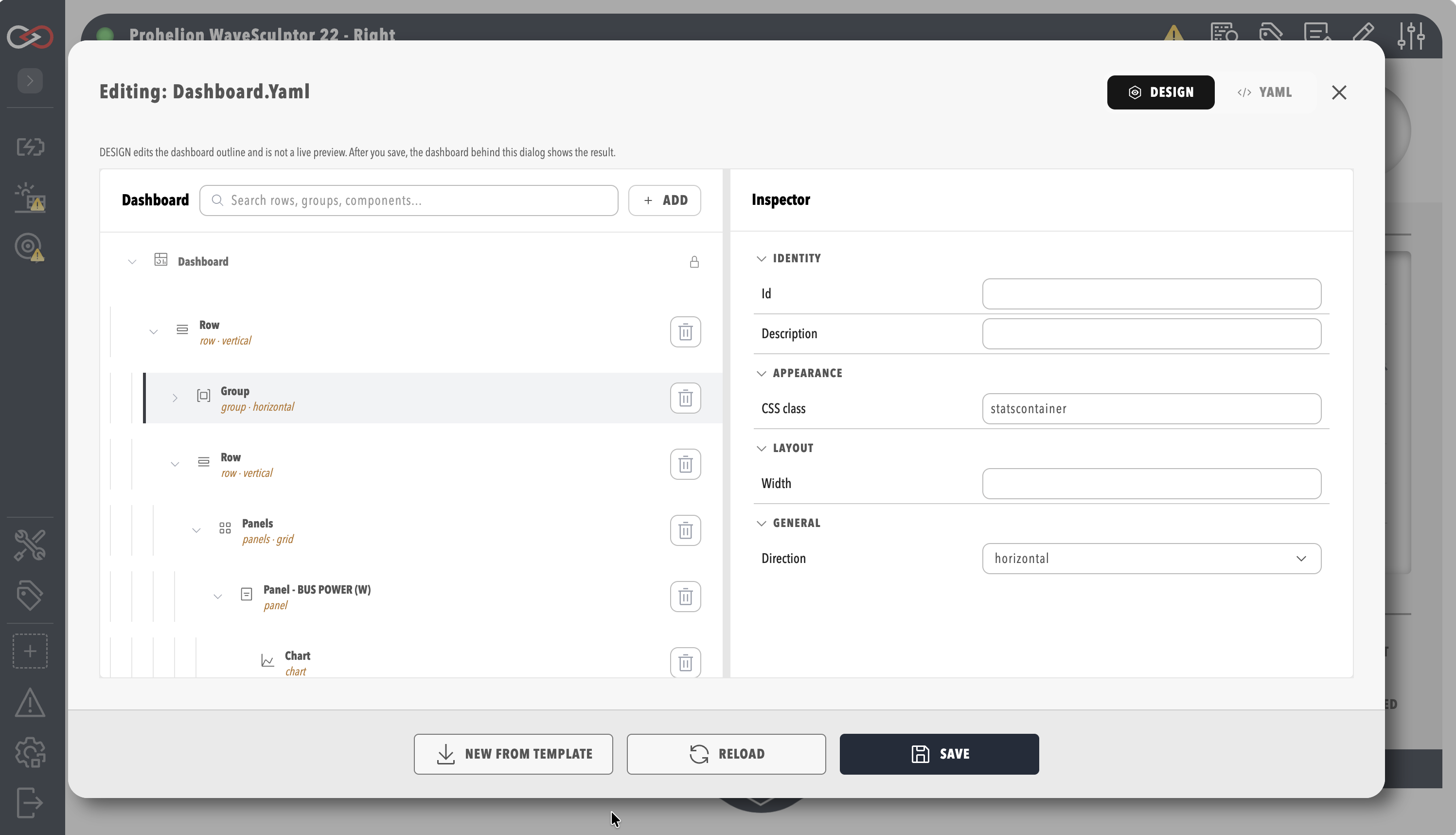
A relative tag path in a Dashboard Component starts at the Dashboard Component itself.
The component has no DBC, so a path such as DBC/BusMeasurement/BusVoltage finds no tag there.
Bind to the tags of another component with an absolute path that starts with /, such as /Prohelion BMU/DBC/PackStateOfCharge/SOCPercent, where Prohelion BMU is the name of the BMU component in the Example Profile.
Use the name of your own component.
To connect the dashboard to tags, refer to Data binding. For each element, refer to the Component reference. Worked guides are How to create a custom dashboard and Profile Dashboard.
Troubleshooting
| What you see | Cause | What to do |
|---|---|---|
| "There is already a component in this profile with that name" | The name matches another component in the profile, or matches an existing dashboard file | Enter a name that is unique in the profile, then select ADD COMPONENT. |
| An element bound with a relative path shows no value | A relative path starts at the Dashboard Component, which has no DBC tags, so the path finds no tag | Bind the element with an absolute path that starts with /, such as /Prohelion BMU/DBC/PackStateOfCharge/SOCPercent, using the name of your own component. |